
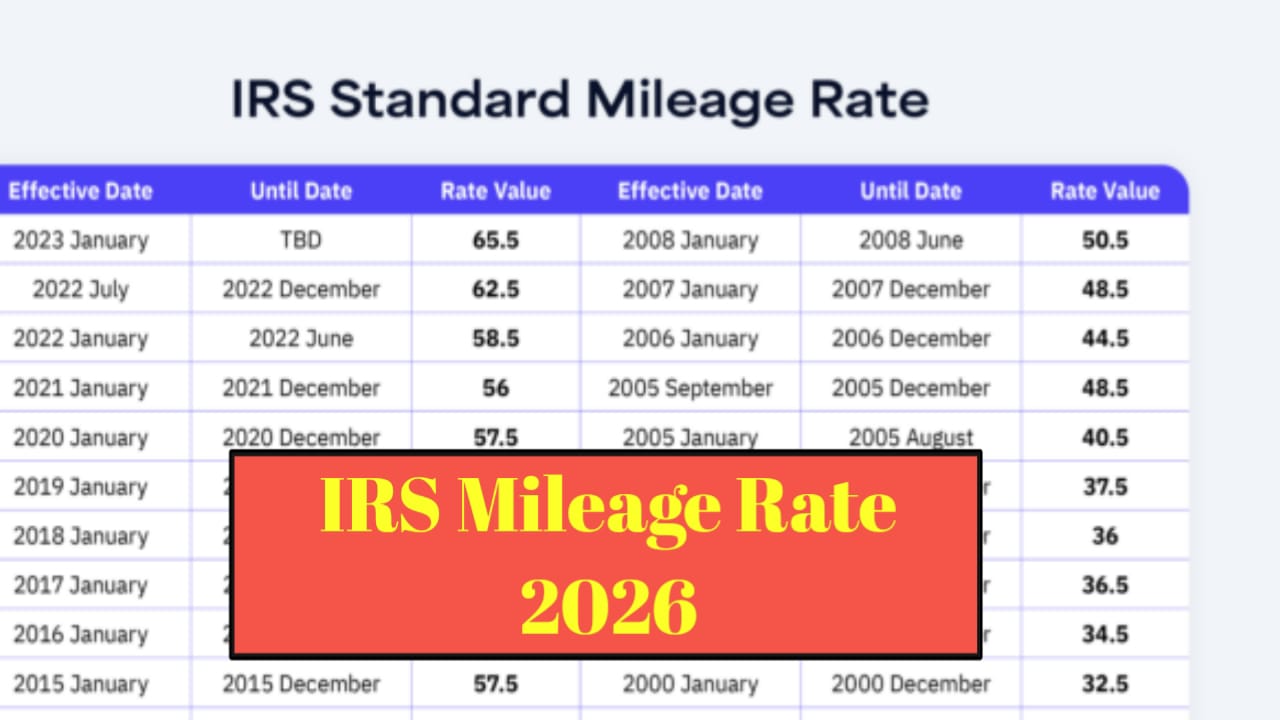
The IRS mileage rate 2026 has been officially announced and will apply to miles driven starting January 1, 2026. According to the Internal Revenue Service, the standard business mileage rate for 2026 is set at 72.5 cents per mile, reflecting a 2.5-cent increase from the previous year. This update impacts millions of self-employed individuals, small business owners, and employees who use personal vehicles for work-related purposes. The IRS releases mileage rates annually through official government notices to reflect changes in fuel prices, vehicle maintenance costs, and overall transportation expenses. These rates are used nationwide for tax deduction and reimbursement calculations and remain one of the most widely used IRS standards each year.
IRS Mileage Rate 2026 Explained
Mileage rates play a key role in reducing taxable income when used correctly. Whether you drive for business, medical reasons, or charitable purposes, understanding the updated 2026 figures can directly affect your tax planning.
This guide provides a clear breakdown of the IRS mileage rate 2026, who can use it, how it works, and what has changed, using the most recent verified information available.
What Is the IRS Mileage Rate?
The IRS mileage rate is a per-mile amount taxpayers can use to deduct vehicle expenses instead of tracking actual costs. It simplifies tax reporting by offering a standardized rate that accounts for fuel, repairs, insurance, and depreciation.
IRS Mileage Rate 2026: Official Rates Breakdown
Below is a complete summary of the mileage rates applicable for tax year 2026.
IRS Mileage Rate 2026 Table
| Mileage Type | 2025 Rate | 2026 Rate | Change | Who Can Use It | Purpose | Deductible | IRS Category |
|---|---|---|---|---|---|---|---|
| Business | 70.0 cents | 72.5 cents | +2.5 cents | Self-employed, businesses | Work travel | Yes | Standard |
| Medical | 22 cents | 22 cents | No change | Individuals | Medical travel | Yes | Special |
| Moving | 22 cents | 22 cents | No change | Active-duty military | Relocation | Yes | Special |
| Charitable | 14 cents | 14 cents | No change | Volunteers | Charity service | Yes | Fixed |
| Depreciation (business) | Included | Included | Adjusted | Business users | Asset wear | Partial | Business |
| Fuel Cost Factor | Variable | Higher | Increase | All users | Gas impact | Included | Business |
| Maintenance Factor | Variable | Higher | Increase | All users | Repairs | Included | Business |
| Inflation Adjustment | Annual | Applied | Yes | All users | Cost changes | Included | Standard |
ALSO READ-
Business Mileage Rate Increase in 2026
The most notable change in the IRS mileage rate 2026 is the increase in the business rate to 72.5 cents per mile. This reflects higher average vehicle ownership and operating costs. Business owners who drive frequently may see meaningful tax savings as a result.
Medical and Moving Mileage Rate for 2026
The medical and moving mileage rate remains unchanged at 22 cents per mile in 2026. This rate applies to unreimbursed medical travel and qualifying moves for active-duty military members.
Charitable Mileage Rate Remains the Same
The charitable mileage rate stays fixed at 14 cents per mile. Unlike other rates, this amount is set by law and does not adjust for inflation.
- Charitable mileage applies only to volunteer work
- Documentation of miles driven is still required
Who Can Use the IRS Mileage Rate 2026?
The standard mileage method is available to self-employed individuals, independent contractors, and businesses using personally owned vehicles. Employees may use it only if expenses are not reimbursed and meet tax qualification rules.
Standard Mileage vs Actual Expense Method
Taxpayers can choose between the standard mileage rate and the actual expense method. Once the actual expense method is selected for a vehicle, switching back may be limited.
- Standard mileage is simpler and widely used
- Actual expenses may benefit high-cost vehicles
Recordkeeping Rules for Mileage Deductions
To claim mileage deductions, accurate records are essential. This includes dates, purpose of travel, starting and ending locations, and total miles driven.
Why the IRS Mileage Rate 2026 Matters
The IRS mileage rate 2026 helps taxpayers keep pace with rising transportation costs. With fuel and maintenance expenses remaining high, the increased business rate provides practical tax relief and more accurate expense representation.
FAQs
Q1. What is the IRS mileage rate for business in 2026?
The business mileage rate is 72.5 cents per mile.
Q2. Did the medical mileage rate change in 2026?
No, it remains at 22 cents per mile.
Q3. Can employees use the IRS mileage rate?
Only if expenses are unreimbursed and qualify under tax rules.
Conclusion
The IRS mileage rate 2026 brings an important increase for business drivers while keeping medical, moving, and charitable rates steady. Understanding these updated figures allows taxpayers to plan deductions more accurately and maximize allowable benefits. By keeping proper records and choosing the right deduction method, individuals and businesses can make the most of the 2026 mileage rates and reduce overall tax liability effectively.
| IRS mileage rate link | Click Here |
| Official Website | Click Here |